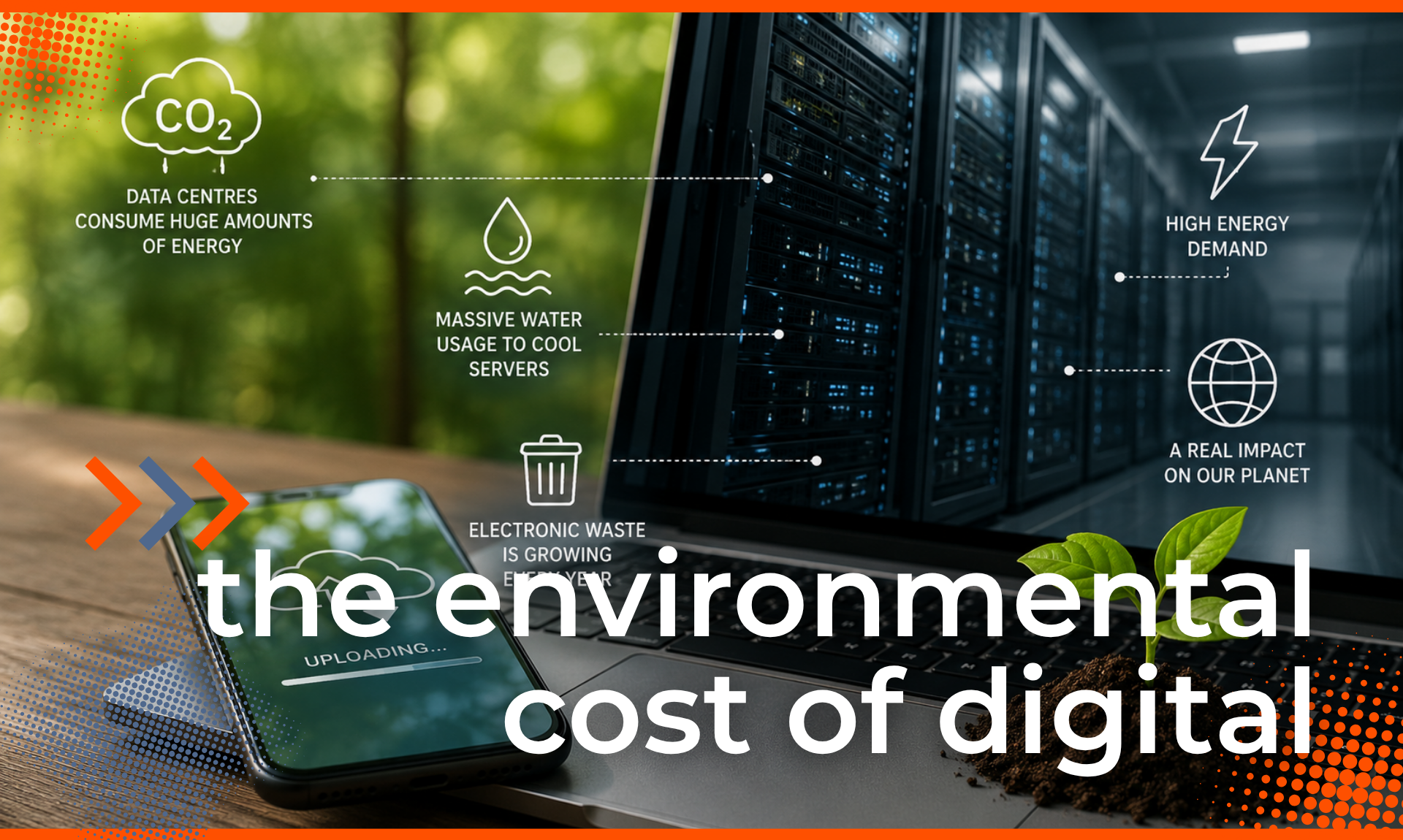
Going digital isn’t necessarily greener.
“Go paperless”. Help the planet.
On the face of it, sounds sensible. Less paper. Less print. Less waste. Job done. Kettle on.
Except, as with most things linked to sustainability, the full picture’s a bit more complicated.
We’re not here to suggest we should all abandon email, shut down the cloud and return to carrier pigeons. Although, to be fair, a pigeon would probably make a nice change from another “just circling back” email.
But the idea that digital automatically means cleaner, greener and impact-free simply isn’t true.
Every search, email, social post, uploaded file, online meeting and AI query needs energy, data centres, cooling, devices, servers, networks.
Digital may feel invisible. But environmentally, it’s anything but.
The growing environmental cost of digital
According to the International Energy Agency, data centres accounted for around 1.5% of the world’s electricity consumption in 2024. By 2030, the IEA expects data centre electricity use to more than double, with AI a major reason for that growth. [1]
Water use is another part of the story. Google’s 2025 Environmental Report states that, in 2024, it consumed approximately 8.1 billion gallons of water across its data centres and offices. Around 22.2 million gallons a day. [2]
And Microsoft reported total water consumption of 1.725 billion gallons in FY23. [3]
That doesn’t mean they aren’t investing in renewable energy, efficiency improvements or new cooling methods. But digital demand is growing rapidly, especially as cloud services and AI become common in everyday business.
So, when people say digital’s greener, the honest answer is ‘mmm, depends’.
A useful comparison
Accounting for around 2.5% of global CO2 emissions, Aviation is seen as one of the biggest contributors to environmental impact.. [4]
Digital is harder to measure because different studies count different things – data centres, networks, devices, supply chains. But estimates place Information & Communication Technology between 1.5% and 4% of global emissions. [5]
That comparison isn’t about making flying look better or digital look worse. But it helps put things in perspective.
Digital isn’t this tiny, harmless thing floating in the ether. It’s a huge physical system. And it’s growing.
The Sustainable Web Manifesto puts it even more starkly, saying that ‘if the internet were a country, it’d be the 4th largest polluter in the world!’ [6] We’re not stating that as fact. But the point remains: digital activity has a real environmental footprint.
Even the small stuff adds up
Take email. The carbon cost of one email is small. But scale changes the story.
Mike Berners-Lee’s figures in his book How Bad Are Bananas? estimate a spam email caught by filters to be 0.03g CO2e. A short email sent and received on a phone 0.2g CO2e. A short email sent and received on a laptop 0.3g CO2e. [7]
So far, so tiny.
But a longer email, taking 10 minutes to write, three minutes to read, sent and received on a laptop, rises to 17g CO2e. And an email blast to 100 people, where only one person reads it and 99 glance at it for a few seconds before ignoring it, is estimated at 26g CO2e. [7]
None of that means we should all stop emailing. It might make business quite tricky! But it does make the case for being more thoughtful. Does everyone cc’d really need to be there? Does the attachment need to be sent or could it sit somewhere with a link? Could the file size be reduced? Could the email be shorter?
One email won’t make or break the planet. But waste is still waste whether it arrives in a bin bag or an inbox.
To underline this, a McAfee / ICF study estimated 62 trillion spam emails were sent a year, using around 33 billion kilowatt-hours of electricity and creating around 17 million tonnes of CO2. [8]
To compare that 17 million tonnes of CO2 with trees, if one tree absorbs around 10kg of CO2 a year, it’d take about 1.7 billion trees growing for a year to absorb that amount of CO2. [9]
That’s a lot of trees. And a lot of emails nobody wanted in the first place!
Big audiences, big impact
The same principle applies to social media.
One estimate reported on Channel 4’s Dispatches in 2020, suggested that if Cristiano Ronaldo’s then 240 million Instagram followers all saw or downloaded a single image post, the energy used could be comparable to powering 10 UK households for a year. [10]
He’s got 667m now – over 2.75x bigger. Just checked. That’s a lot more houses!
We’re not having a pop at Ronaldo, but as an illustration, it does a pretty useful job. When something digital is viewed at huge scale, it uses serious energy.
So where does print fit in?
Print has an environmental impact too. Of course it does. No denying it.
Paper has to be sourced. Ink has to be used. Machinery has to run. Work has to be delivered.
But that doesn’t mean print is automatically a problem. The question to ask is: how responsibly is the print being produced?
Paper is from a natural, renewable material. And in Europe it’s highly recycled. Two Sides reported that in 2023:
- 54 million tonnes of paper were collected and recycled for a recycling rate of 79%.
- paper fibres were reused an average of 3.5 times
- the recycling rate for paper and cardboard packaging was 83%. [11]
The same report also highlights a common misconception. People assume European forests are shrinking. In fact, between 2005 and 2020, they grew by 58,390 square kilometres. That’s an area bigger than Switzerland, and equivalent to 1,500 football pitches every day. [11]
That’s why responsible sourcing matters.
KNP is FSC certified, which means we use paper that comes from responsibly managed forests and traceable supply chains. [12]
We’re also ISO14001 certified. ISO14001 is the international standard for environmental management systems, helping organisations manage environmental impact, improve performance and build environmental responsibility into day-to-day operations. [13]
What responsible print looks like in practice
For us, responsible print isn’t just a nice idea. It’s something we work on every day.
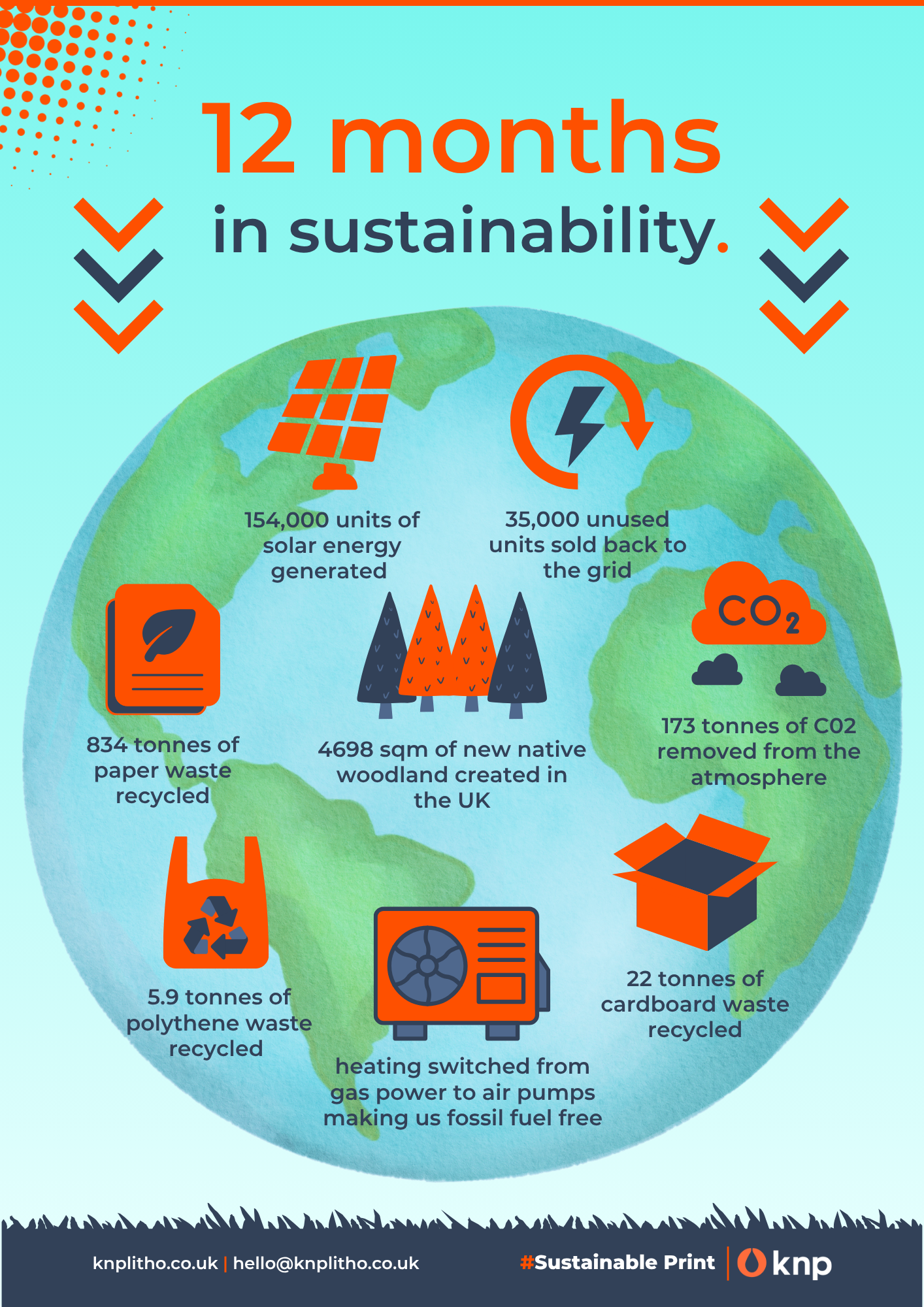
Our home is carbon neutral and fossil fuel free, powered by 600 rooftop solar panels that generate around 154,000 units of energy. We’ve also returned 35,000 unused units back to the grid before. [14]
We use vegetable-based inks, helping reduce the need for harsher chemicals in the print process. [14]
We recycle as many elements of the print process as possible, including metal printing plates, toners, lamination film waste, paper, plastic and aluminium. Over a 12-month period, we recycle around 834 tonnes of paper waste, 22 tonnes of cardboard waste and 5.9 tonnes of polythene waste.
And we plant a tree for every new job placed with us.
All of this shows what can happen when print is produced with thought, care and accountability.
The real answer is responsible communication
The environmental question shouldn’t be “print or digital?” Business needs both. Digital is brilliant for speed, convenience, automation and reach. Print is brilliant for attention, trust, tangibility, impact and staying power. And the smartest communication often uses the two together.
The question should be:
- Are we communicating responsibly?
- Are we choosing the right channel for the job?
- Are we avoiding waste?
- Are we working with suppliers who take sustainability seriously?
- Are we thinking about the whole impact, rather than the bit we can see?
Because “paperless” doesn’t automatically mean planet-friendly. And responsibly produced print performs an effective, efficient and sustainable role in how businesses communicate.
At KNP, that’s what we believe in. Better, smarter, more responsible communication.
If you do to, we should talk. Because we should do it together.
Sources
[1] International Energy Agency — Energy and AI: Executive Summary
[2] Google — 2025 Environmental Report and Data Centre Magazine summary of Google’s 2025 Environmental Report
[3] Microsoft — 2024 Environmental Sustainability Report Data Fact Sheet
[4] Our World in Data — What share of global CO2 emissions come from aviation?
[5] International Telecommunication Union — ICT sector GHG emissions
[7] The Carbon Literacy Project — The Carbon Cost of an Email: Update
[8] McAfee / ICF International — The Carbon Footprint of Email Spam Report
[9] MIT Climate Portal — A Supply Curve for Forest-Based CO2 Removal and One Tree Planted — How Much CO2 Does a Tree Absorb?
[10] University of East London — Are our social media posts hurting the planet? and Channel 4 Dispatches clip via Facebook
[11] Two Sides — Print and Paper Myths & Facts
[12] https://fsc.org/en